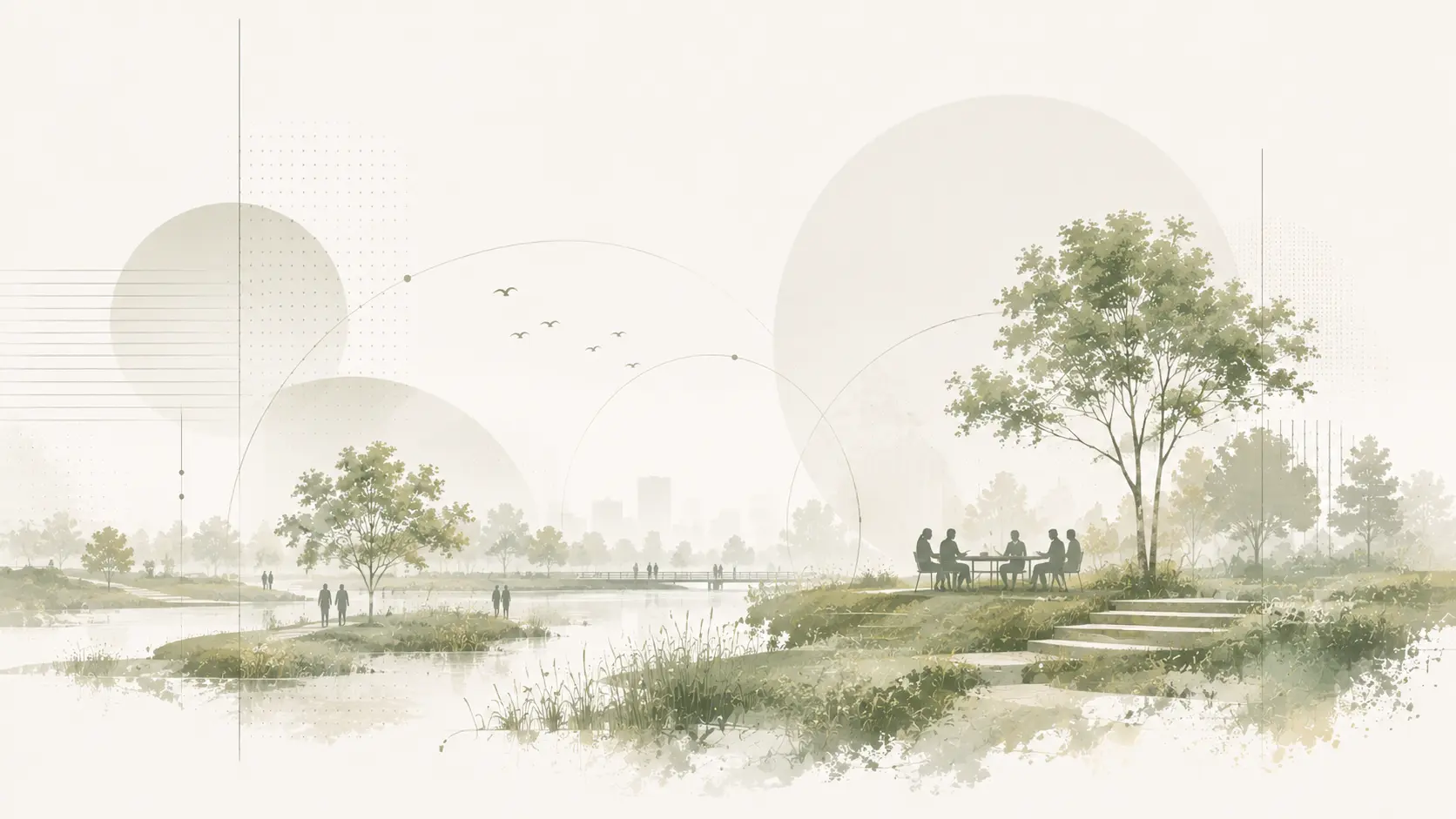
Working Together
Every project begins with a different place, a different team and a different set of ambitions.
For that reason, collaboration is never based on a fixed formula. The approach is adapted to the context of each commission, bringing together landscape architecture, climate adaptation and interdisciplinary design from the earliest stages of a project.
Landscape architecture is a collaborative discipline
Successful projects are developed through the combined knowledge of clients, architects, engineers, ecologists, public authorities, researchers and local communities.
The role of landscape architecture is to connect these perspectives into a coherent landscape strategy that responds to place, climate and everyday use.
No two projects follow exactly the same path. The process is adapted to the project rather than asking the project to adapt to a predefined methodology.
Areas of Work
The practice contributes to projects at different scales, from early strategic thinking to detailed landscape design and implementation support.
-
Landscape Architecture
Public spaces, institutional landscapes, campuses and building-related open space.
-
Public Space
Squares, streets, parks and neighbourhood environments designed for everyday life.
-
Landscape-led Masterplanning
Landscape systems that organise future urban development.
-
Climate Adaptation
Projects addressing heat, water, biodiversity and long-term environmental resilience.
-
Nature-Based Solutions
Integration of ecological systems into practical spatial design.
-
Strategies & Guidelines
Landscape frameworks, urban greening strategies and implementation guidance.
-
Competitions & Design Collaboration
Participation in interdisciplinary design teams from the earliest concept stages.
Project Support
Projects are supported from the first idea to built reality — across all planning phases (LP1–LP9).
The core of the practice is nature-based solutions: shade, water, soil, vegetation and biodiversity treated as working systems that carry a design, not as additions to it. This expertise has been applied at every scale — from heat-mitigation guidelines for nine municipalities of the Attica Region and metropolitan river landscapes in China to neighbourhood squares in Athens and planting plans drawn at 1:100.
The work spans an unusually wide range of open-space typologies — public squares and promenades, metropolitan and neighbourhood parks, river and coastal landscapes, university and research campuses, bathing landscapes, landmark structures, and research, guidelines and policy. Each commission draws on lessons carried across these very different contexts.
Particular value lies in the early phases (LP1–LP4), where spatial structure, ecological performance and long-term quality are decided. Depending on the commission, support continues through detailed design, tendering and construction (LP5–LP9) — including projects carried from first prize in competition to implementation.
How Projects Develop
- Understanding the place
- Understanding ambitions and constraints
- Landscape strategy
- Design development
- Coordination
- Detailed planning
- Implementation support
Ways of Working
Possible formats include:
- Direct commissions
- Municipal projects
- Architecture office collaborations
- Competition teams
- European projects
- Strategic advisory roles
- Research partnerships
Frequently Asked Questions
Which planning phases are supported?
Projects can be supported throughout all planning phases. Particular emphasis is placed on the early stages of planning (LP1–LP4), where spatial structure, ecological performance and long-term project quality are established.
Do you work throughout Germany?
Yes. The practice is based in Hamburg and works primarily across Germany, with selected projects in Greece, Cyprus and other international contexts.
Can you join existing design teams?
Yes. Collaboration with architecture offices, engineers and interdisciplinary planning teams is a regular part of the work, and the process is adapted to each project rather than following a fixed formula.
How are previous projects credited?
Transparently. Each project identifies the responsible organisation, the collaborators involved and Dimitra Theochari's precise role within the team.
Can you support competitions?
Yes. Competition work within interdisciplinary design teams, from the earliest concept stages, is one of the established formats of collaboration.
Can you contribute before design begins?
Yes. The strongest emphasis of the practice lies in early strategic work—landscape strategies, guidelines and feasibility thinking—where project direction is still open to be shaped.
Let's start with the place
Every project begins by understanding the place, the people involved and the ambitions of the project.
If you are looking for a landscape architecture partner, collaboration on a competition, support with climate adaptation or an early design conversation, you are welcome to get in touch.
The first discussion is not about finding immediate solutions.
It is about understanding the project well enough to identify the right direction.