A Practical Design Framework
Ecology of Comfort
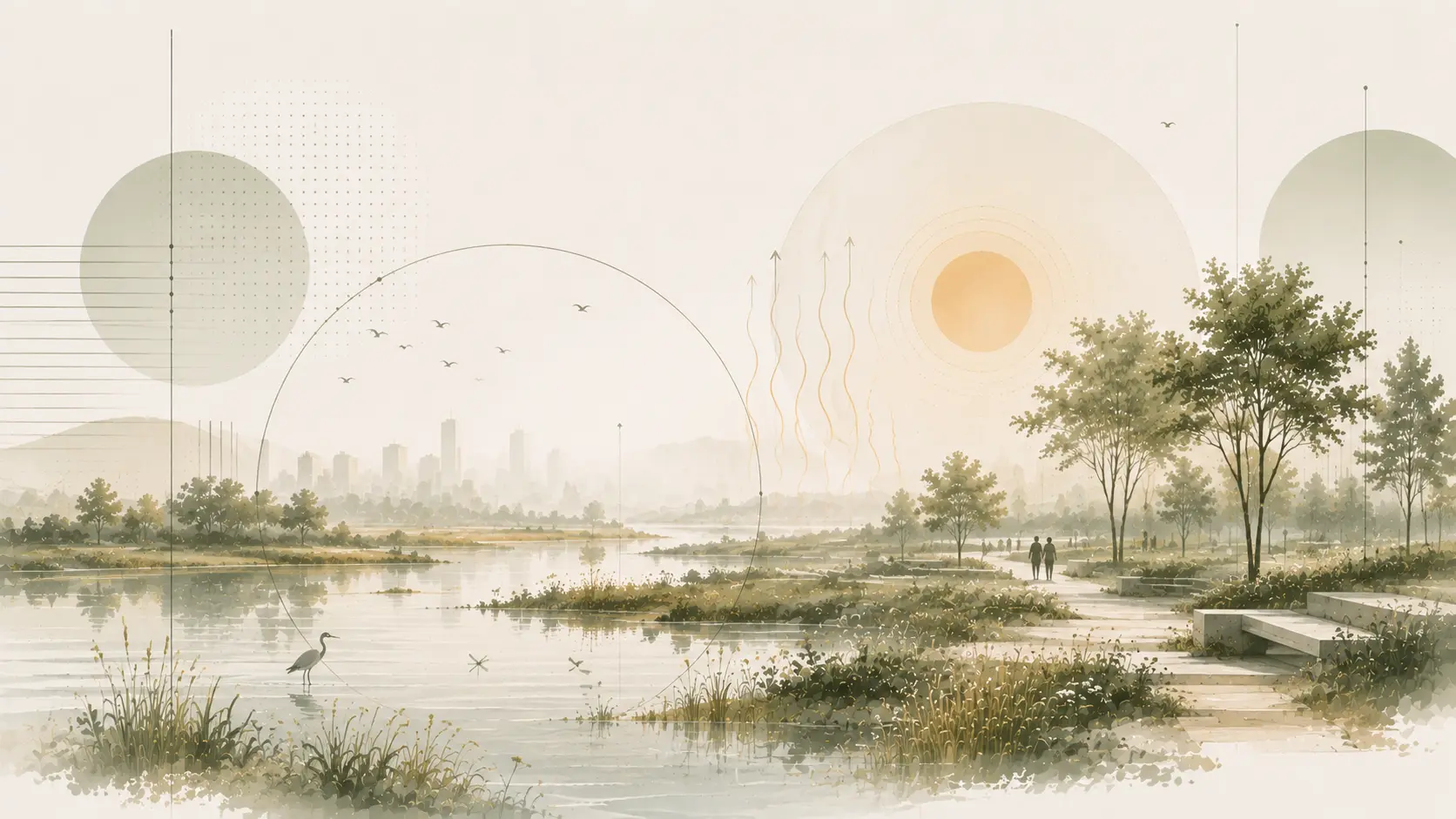
Ecology of Comfort describes a way of approaching landscape architecture in which ecological systems and everyday public life are considered together from the beginning of a project.
What the Framework Asks
The framework asks how water, soil, vegetation, biodiversity, shade and climate can support ordinary activities such as walking, resting, meeting, playing and spending time outdoors.
It is less concerned with adding ecological elements to finished designs than with allowing ecological systems to become part of the spatial structure of a place.
Ecology of Comfort is not a trademark, an ideology or a fixed methodology. It provides a coherent language for recurring questions that have emerged through years of professional practice—without suggesting that there is a single formula.
Read the full manifestoThree Guiding Questions
These questions are deliberately simple, and they appear consistently throughout the work.
Can people live comfortably here?
This concerns thermal conditions, accessibility, inclusion, safety, public life and everyday use.
Can ecological systems thrive here?
This concerns soil, water, biodiversity, vegetation, habitat, maintenance and resilience.
Can both continue to improve over time?
This concerns growth, stewardship, adaptation, realistic maintenance and long-term performance.
How the Framework Relates
To Nature-Based Solutions
Nature-based solutions are one important tool within Ecology of Comfort. They are not the framework itself. Nature-based solutions answer technical and ecological questions. Ecology of Comfort asks how those technical systems become meaningful public space.
To Landscape Architecture
Ecology of Comfort reinforces landscape architecture; it does not replace it. Landscape architecture remains the discipline. Ecology of Comfort explains one way of practising it.
To Architecture
Buildings create destinations. Landscape shapes the spaces between them. The framework recognises architecture and landscape architecture as complementary disciplines whose strongest projects emerge through collaboration.
Six Conditions
The framework can be read through six conditions of comfort. Each condition raises practical questions that recur across projects, from public squares to masterplans.
-
Thermal Comfort
Where is shade needed? How does radiant heat affect movement? How do materials influence perception?
-
Hydrological Comfort
Where does water go? How can it remain useful? Can stormwater contribute to public life?
-
Ecological Comfort
Which habitats exist? How can biodiversity become spatially visible? How can vegetation mature over decades?
-
Social Comfort
Can people stay? Is there dignity? Are different age groups supported?
-
Cultural Comfort
What makes this place specific? Which histories and routines matter? How can local identity remain visible?
-
Temporal Comfort
How will the project perform in 20 years? What maintenance is realistic? How will the landscape change?
Not every project engages all six conditions. Project pages describe only those genuinely relevant, which keeps the framework honest.
A Simple Understanding
Landscape architecture can create places where ecological systems and everyday life support one another over time.
That idea is grounded in built projects, competitions, strategies and guidelines rather than presented as a finished doctrine.